
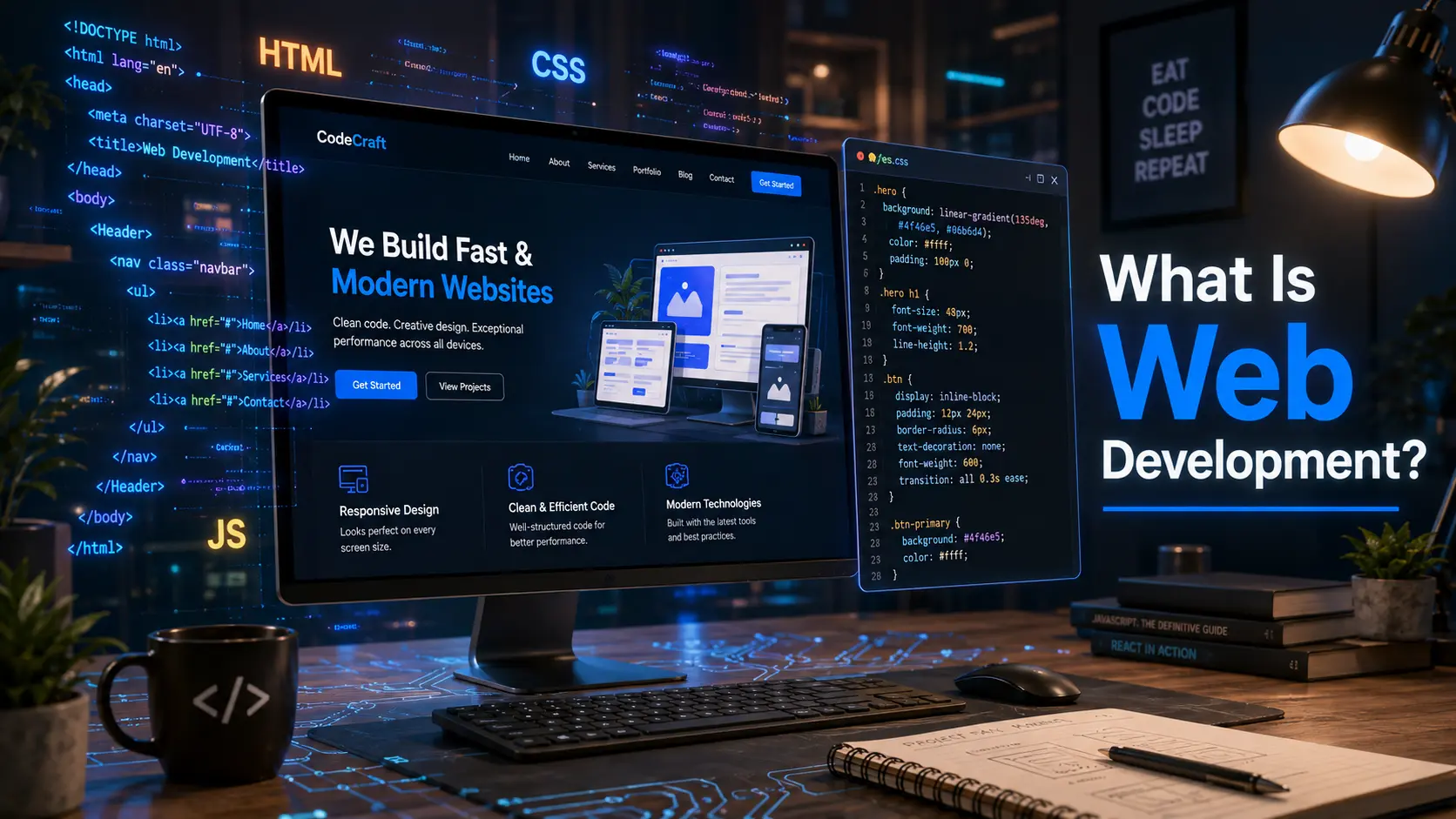
What Web Development Actually Is
If you've ever typed something into Google and landed on a page that just works — a form that submits, a tool that converts your file, a blog that loads fast — someone built that. That's web development. Not some mystical AI-era buzzword, just the actual craft behind the things you use online every day.
It comes down to three layers, stacked on top of each other:
- HTML — the structure. Headings, paragraphs, buttons, forms — the skeleton of a page.
- CSS — the styling. Colors, spacing, fonts — what makes it look like a page instead of a plain document.
- JavaScript — the behavior. What happens when you click, type, or scroll.
Everything else — frameworks, backends, databases, hosting — sits on top of these three. And here's what most beginners don't realize until much later: you don't need to master all of it before you start getting real value out of it.
The "Earn While You Sleep" Idea, Explained Honestly
Most jobs trade hours for money. Stop working, the money stops. A website doesn't work like that. Once a tool or a blog is live, it can keep pulling in visitors — and revenue — at 2 AM while you're asleep, on a weekend, on a day you didn't touch the code at all.
That's the actual pull of this skill. Not "get rich fast" — the site itself becomes an asset that keeps producing, through ads, subscriptions, affiliate links, or a product you sell through it.
iLovePDF: A One-Page Side Project That Went Huge
iLovePDF started in 2010 in Barcelona as a small side project by designer-developer Marco Grossi. No funding, no big team, no marketing budget — just a simple tool that merged, split, and converted PDFs, and did it without asking you to sign up first.
Today it's one of the most-visited utility sites in the world, largely running on subscriptions now. The founder has reportedly turned down acquisition offers. A free tool built to solve one annoying problem quietly became a business bigger than most startups.
A Blogger Who Started With a $10 Payment
Closer to home — Harsh Agrawal runs the blog ShoutMeLoud. His first-ever online payment was $10, for fixing someone's WordPress issue. Not a big story on its own, but the starting point matters: he didn't even know what AdSense or affiliate marketing was when he began.
These numbers come from his own published income reports and independent write-ups — not audited figures, so hold them loosely. But the trajectory is the real lesson here: it started from zero, from one blog post, from not even knowing the tools existed yet.
Why Right Now Is a Good Time to Start
Because the barrier to starting has genuinely dropped. You don't need a computer science degree to put your first page live, and you don't need to memorize syntax before you're allowed to build something real.
How to Actually Begin
Just HTML and CSS to start. You're not aiming for mastery, only enough to read a page and change something on it.
A portfolio page, a small tool, anything. Ask Claude to help you write it and explain the parts you don't follow yet.
GitHub Pages with Cloudflare in front of it costs nothing and is enough to get a real, working site online today.
Build a second thing, then a third. Somewhere around there you'll notice what part you actually enjoy — that's what to go deeper on.
Mistakes Beginners Make Early On
- ✓ Waiting to feel "ready" before building anything — you learn by shipping something small, not by reading forever
- ✓ Trying to learn every framework at once instead of getting comfortable with plain HTML, CSS, and JS first
- ✓ Copying code without asking why it works — that's the one habit that actually slows you down long-term
- ✓ Expecting income in month one — even the examples above took sustained time before money showed up
- ✓ Building in private for months instead of putting something live early and improving it in public